


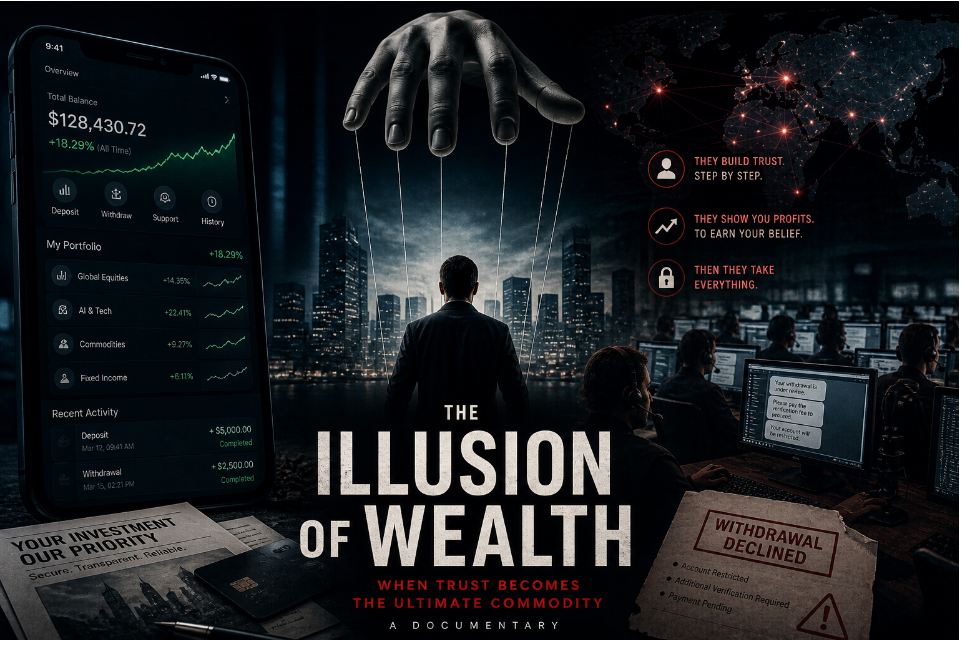
In an age defined by rapid digital transformation, a new and deeply sophisticated form of financial deception is taking hold—one that relies not on obvious fraud, but on carefully engineered trust. The Illusion of Wealth, an upcoming documentary backed by Nord-Quant, offers a powerful and unsettling exploration of this emerging threat, revealing how modern scams are evolving to not only mimic legitimacy—but surpass it.
A New Era of Scams
Gone are the days of poorly executed schemes and transparent trickery. Today’s fraudulent operations are highly refined, leveraging advanced design, seamless user experiences, and professional-grade communication to replicate the look and feel of legitimate financial institutions.
What distinguishes these operations is not just their appearance—but their ability to cultivate genuine trust. From responsive customer service to early investment returns and even successful initial withdrawals, victims are not abruptly deceived. Instead, they are gradually and convincingly led into belief.
Inside the Psychology of Trust
At the core of The Illusion of Wealth lies a compelling question:
What happens when fake companies become better at earning trust than real ones?
Structured in six acts, the documentary traces the full arc of these schemes:
- “The Perfect Illusion” introduces platforms that appear more efficient and credible than traditional institutions.
- “The First Win” delivers early success, reinforcing confidence through tangible returns.
- “The Machine” uncovers the organized infrastructure—call centers, scripted persuasion, and data-driven targeting—behind the scenes.
- “Escalation” shows how victims deepen their financial and emotional commitment, even as warning signs begin to surface.
- “The Trap” marks the turning point, where withdrawals are restricted and new barriers emerge.
- “Aftermath” leaves victims confronting loss, confusion, and the haunting question of when they could have walked away.
Why This Story Matters
As financial systems become increasingly digital, trust is no longer built through personal relationships—it is constructed through interfaces, branding, and user experience. Meanwhile, regulatory frameworks struggle to keep pace, creating an environment where sophisticated scams can thrive at scale.
The Illusion of Wealth highlights a critical shift: credibility itself is becoming a manufactured product.
Beyond Fraud: A Systemic Investigation
More than a documentary about scams, The Illusion of Wealth is a broader examination of the systems that enable them. It explores the industrialization of trust, the psychology of belief, and the increasingly blurred line between authenticity and illusion in the digital economy.
Rather than focusing solely on how these schemes operate, the film challenges audiences to consider a deeper question:
Why do they continue to succeed?
A Cinematic Experience
Visually, the documentary adopts a premium true-crime aesthetic, blending sleek financial interfaces with the hidden mechanics behind them. Through a mix of real footage, reconstructed scenarios, and insider perspectives, the film delivers an immersive and psychologically engaging narrative.
Its tone is intentionally intimate and unsettling—designed to resonate with viewers and underscore a sobering reality: under the right conditions, anyone can be drawn into these systems.
Positioned for Global Audiences
With growing demand for true-crime and financial exposés, The Illusion of Wealth is well positioned for major streaming platforms, appealing to a global, digitally aware audience aged 25 to 55. Its universal themes and real-world relevance make it both timely and compelling.
Nord-Quant’s Vision
For Nord-Quant, the documentary represents part of a broader initiative to explore financial systems, behavioral economics, and the evolving nature of trust. The company is pioneering what it calls “financial reality storytelling”—a genre that goes beyond exposure to challenge how audiences understand and engage with modern financial ecosystems.
The Takeaway
In a world where legitimacy can be designed, scaled, and sold, the most dangerous scams are no longer the ones that appear suspicious.
They are the ones that look exactly like something you would trust.
Because ultimately, the real commodity is not money.
It is belief.
